Saturday, September 15, 2012

UBIMS Changes Supply Chain Quality

                                  by Jess Parmer
We have stressed on this blog over the last few years the price and competitive improvements that will result from adoption of the UBIMS platform by end-user businesses and suppliers.  In capsule form, these improvements result from UBIMS’s direct assault on time and space constraints imposed by private supply chains in the service of ultra-large job-killing machines in our domestic economy, and in the world at large.  End-users—not limited to local retailers and service providers, but also including the retail customer—and employees have, under the regime of competition by size, suffered disproportionately.  The UBIMS solution offers definable relief from immediate impacts of the rigged private supply chain, but is there more?
One answer to such a question may be intuited from the U.S. healthcare system’s coming adaptation of unified service and supply platforms:  the leading innovators in IT applications in population health incorporate from the start of the change process careful attention to customer satisfaction alongside development of provider confidence in the outcomes fostered by IT change.  The nature of these developments, while not yet universal, is useful for thinking about what improvements may be sought in other real, functioning markets through UBIMS.  Is it realistic to expect a UBIMS public supply chain to reduce prices, to cut delays, and at the same time to improve quality—whether stated as quality of service, or of manufacture, or as measured in some other way?
Perhaps a better analogy than the health care system can be imagined:  suppose for a moment that all delicatessens in a large city could order directly from manufacturers all the foods not made in-house on a UBIMS platform.  Delicatessens typically allow customers small samples, such as a slice of corned beef or several bites of potato salad, prior to purchase.  All delis powered by UBIMS could collect customer impressions of quality in this exact moment and forward it directly to manufacturers, linking these to manufacturers’ lot numbers, dates of expiration, nutritional information, etc.  Amazon, for instance, solicits customer responses right on the page where orders can be placed, and Amazon’s vendors also request and publish on the same page customer satisfaction rankings.  But Amazon itself also has a stake in this, often being their vendors’ competitor, so that it is small wonder that the Amazon supply chain is littered with warnings about limited numbers of items available.
But since UBIMS is a public supply chain platform, it will have no stake in the availability of specific items, or in their prices, and via the UBIMS rule of fair trade no stake in delivery cost.  In fact, the analogy with amazon.com goes only so far in explaining the power of a public supply chain platform.  The after-market in private passenger vehicles, despite the viral growth of CarMax and its imitators and the availability of accident databases by VIN number, presents numerous opportunities for informing consumers as fully as possible prior to purchase.  Even with such highly standardized products, UBIMS would find room for operation through owner service records and parts replacement validation, just to name a pair of areas in this massive market that would benefit from a public supply chain platform.  The popularity of the PBS Radio show, Car Talk, illustrates the breadth and depth of opportunities in this market.
A third example of a market that could develop rapidly under a UBIMS public platform is that of consumer appliances:  Consumer Reports touches only one edge of the information potentially usable from implementation of UBIMS here.  The problem in this area is that there is virtually no public aftermarket in used appliances, as our landfills testify.  Even smaller cities could benefit from a fact-based market in these, as landlords seek to fill semi-furnished rentals and new homebuyers stock their properties with appliances—often in the futile hope of avoiding a large home-improvement loan to do so.  Emergent technologies in heating and cooling can also complicate purchasing plans by lacking long service records.  A data-based approach to this market could convert a scrap operation into a thriving after-market business in major household appliances, or turn the small appliance department of a large used-goods store into a business with reliable profits, ending forever the appeal of cheap imported goods in this market and giving the big-box stores some real competition.  Buying reliable used appliances could come to resemble buying clothing in stores where you get to try things on before purchase, the difference being that someone else has tried on the appliance and told you his or her experience with a specific example of product.
The basic product of the UBIMS supply chain system is information relevant to market participants, publicly available in a model of cooperation and validation under an overall model of absolute competition, as opposed to competition based on size alone.  Quality assurance is the fundamental criterion of markets in goods and services—quality that is assured by reliable information in an open system that cannot be gamed or otherwise compromised.  This is the medium- and long-term promise of UBIMS, and it is why the UBIMS public supply chain platform will become the commercial platform of choice.

Wednesday, July 4, 2012

Job-Killing Machines in the Modern Information Age

by Luke Ho-Hyung Lee
We have developed numerous “job-killing machines” in the real market (or supply chain process) through the use of IT and networking technology over the last 20 to 30 years of the Modern Information Age.  These machines have significantly contributed to the shift to a more efficiency-oriented supply side environment by killing jobs and have altered the whole economic environment.  Strangely, it seems nobody has recognized this yet, and no expert has considered this at all in his or her public ruminations about the economy.
What are the job-killing machines in the real market process?
As you may have recognized, every company on the supply side has aggressively adopted IT and electronic networking mainly to increase its own productivity and efficiency in the functional real market process.
By developing many kinds of market (transaction or supply chain) systems and applications through the use of IT and networking technology in this way, two major effects are to be observed: (1) the number of transactions and functions in the supply chain process has shrunk remarkably—as with Wal-Mart, e-buyer, e-seller, and e-auctioneer systems, and existing e-marketplace systems in the real market process—and (2) numerous collaborative activities to increase efficiency of function have arisen in all sectors of the real market.   
Finally, by integrating those two major activities, numerous private information-based supply chain networks (mostly in big companies) have developed in all industries, and virtually only the big companies benefit.
Due to the superior position of big companies with their own efficient supply chain networks, the businesses of small- and medium-size companies have weakened and eventually been destroyed, and accordingly, many jobs in those companies also have been killed.  Moreover, these private information-based supply chain networks have contributed to the shift to a more efficiency-oriented supply side environment and changed the whole economic environment in the Modern Information Age.  That is, a mutually complementary relationship between the supply side and the existing market process has been firmly established, and this has completely altered the economic environment.  Thereafter, the following activities have been significantly facilitated in almost all industries on the supply side by killing numerous jobs in the domestic market: (1) aggressive adoption of IT progress, (2) off-shoring and outsourcing activities toward lower-labor cost countries, and (3) broad adoption of robotic machines and automation processes equipped with information (software) devices.
In this situation with the private information-based supply chain networks in the real market process, employment has continually and inevitably declined, and policies aimed at improving it have been unsuccessful.  Therefore, it could be said that private information-based supply chain networks have been the major job-killing machines in the Modern Information Age.
What is the private information based supply chain network?
Let me explain more details about the private information-based supply chain network with an example, the Zara case:
Zara, the largest clothing company in the world, developed a private information-based supply chain network by vertically integrating its logistics and collaborative functions through the use of IT and networking technology and now needs just two weeks to develop a new product and get it to its own stores, compared with a six-month industry average, enabling Zara to launch around 10,000 new designs each year, far more than its competition.
Zara has been remarkably successful over the last 20 to 30 years, and as a result, Amancio Ortega, Chairman of Zara, was named the fifth richest person in the world by Forbes in 2012.
But what happened to others in the industry?  Most small individual designers, manufacturers and stores were much less competitive than Zara, and most of them in their supply chain lost their businesses. That is, the whole supply chain in this industry became seriously unstable. Only some of them could be subordinated to Zara for survival.  As a result, the employment situation for middle- and lower-income workers in this industry has seriously and relentlessly deteriorated.  Unfortunately, Zara is no longer an isolated case.
Large companies in every industry have developed similar private information-based supply chain networks for their own distribution, and those big companies have used their supply chain networks only for their own benefit.  Thereafter, sadly, the employment situation for middle- and lower-income workers has seriously worsened in almost all industries, worldwide. 
Let me ask you directly:  “Without first replacing those job-killing machines, can you change this worsening course of the employment situation and revitalize the economy?  That is, can you solve the current economic crisis only with the old economic policies or stimulus plans?”  I believe it to be impossible in most existing market or supply chain processes.  That’s the real problem.
What should we do then?
Remember, we had also developed numerous private information networks in information until the Internet as a meta-platform was introduced and popularized in 1996.  What has happened in employment since then?
On the basis of the Internet, we could have developed numerous web-based software applications, software platforms such as Facebook and platform devices such as smart phones. Further, we could also have developed numerous platform-based software applications on the basis of those software platforms and platform devices. That is, we could have created numerous new businesses and jobs in the IT and Internet sectors of the market. Those meta-platform, software platforms, and platform devices were major job-creating machines in the information process, or so we were told at the time.
A question is raised: “Why haven’t we developed such a meta-platform or platforms also in the real market process?”
Unfortunately, without being aware of it, we have made a simple but serious mistake in developing many kinds of market, transaction, or supply chain systems and applications based on information technology.  As a result, information technology has been used in the wrong way in developing those systems and applications.  Thereafter, no competing public information-based supply chain infrastructure as a meta-platform in the real supply chain process has been developed.  (Please see more details about the mistake in “The Real Cause of the Current Economic Crisis and a Suggested Solution”.)
Another question is raised: “Is it possible to develop such a meta-platform as a job-creating machine also in the real market or supply chain process?”
To answer this question, we must be clear about what the Internet is.  It is a meta-platform for efficiently transferring information (digital codes) between multiple information sources and recipients.  Is it also possible to develop such a meta-platform for efficiently transferring physical objects and services between multiple suppliers and customers?  Yes, it is possible.  The concepts are the same, even if one is for transacting information and the other one is for transacting the sale and purchase of physical objects and services.
I believe the conditions and circumstances for the development of such a meta-platform, that is, a new public information-based supply chain infrastructure, are already in place.  That is, information technologies, facilities, devices, and people are already in place to develop it.  The only issue that remains is the will to develop it.  Moreover, the solution is already in sight.  It only needs to be implemented.  Once decision-makers are willing to make the necessary choices, it will be relatively easy to implement, and it will not take long to see positive results.
I believe there will be no sustainable solutions for the current economic crisis until the existing job-killing machines, that is, the private information-based supply chain networks, are replaced by a new job-creating machine, that is, a new public information-based supply chain infrastructure (or platform) that helps rather than disrupts and destroys existing businesses.
I would strongly recommend that governments and leaders of the Western countries, especially the United States and the Euro-zone countries, initiate the development of this new job- creating machine, and provide the active assistance and support necessary to revitalize their own economies and also the world economy, and that we do so immediately.
Time is running out.  The old private supply chain networks continue to shed jobs and wreck businesses.  This new public information-based supply chain infrastructure can and will reverse these effects in time to avert collapse.

About the Author
Ho-Hyung (Luke) Lee (luke.h.lee@ubims.com) is by training a lawyer, an international businessman and entrepreneur – and an inventor. He is currently the CEO of UBIMS, Inc. ("Ubiquitous Market System"). UBIMS, Inc. is a patent-pending startup with a new business method and system for the information-based public supply chain infrastructure.

Monday, March 12, 2012

To have Prosperity or to have Decline, it depends on Your Choice

by Luke Ho-Hyung Lee

How many public bridges as infrastructure are in the San Francisco Bay area? How many those bridges are in the United States? How many in the whole world? 

If all of those bridges were not public infrastructure but private, and only the owners (mostly big companies) could use their bridges for their own benefit, what would have happened in our economy and society?

The most likely development would have been that, due to the superior position of big companies in efficiency, the businesses of small- and medium-size companies would have weakened and eventually been destroyed, and accordingly, many jobs in those companies would also have disappeared.  Job creation in the market as a whole would have been sluggish as well.  In addition, while the profitability of the general service industry was also seriously diminished, we would have experienced a risk of a vicious cycle with a rapid reduction of total consumption.  Correspondingly, the expanding gap between poor and rich would have become inevitable.… Our society could have anticipated increasing unrest.…  

In this situation, what actions should national governments have taken?  First of all, they ought to have adopted a series of powerful expansionary monetary and fiscal policies, and stimulus plans aimed at preventing the vicious economic cycle due to reduced total consumption, and not have hesitated to activate deregulation to revive the overall market.  Moreover, in order to calm climbing social unrest, the implementation of generous welfare policies--even populist policies--would have been unavoidable….  As a result, numerous national fiscal statuses would have continued to get worse, pushing weaker national economies toward default.
 
Even if the above is a hypothetical scenario on the basis of "what if,” it looks uncannily similar to the situation that the world economy including the US has experienced over the last several years.

We have developed numerous information-based private supply chain networks in the market over the past 20 to 30 years of the Modern Information Age through the use of advanced information technology.  As a matter of course, most of these networks have been developed mainly by large companies and are used only for their own benefit.

Then, how about the information-based public supply chain infrastructure?  Even if it is hard to believe, no such public infrastructure has been developed at all--not a single one in the whole world!

How could this happen?  Unfortunately, a situation analogous to that imagined world without public bridges has actually happened in the supply chain process of the Modern Information Age.  The real problem is that no one (except me) has recognized this until now. 

Unfortunately, without being aware of it, we have made a simple mistake in developing numerous supply chain systems based on information technology over the last 20 to 30 years.  As a result, information technology has been used in the wrong way in developing those supply chain systems. Thereafter, no competing information-based public supply chain infrastructure could have developed in the market.

What "mistake"?  Even if some technological expertise is required, it is a fact that one of the most important factors in real (or physical) transactions, that is, overcoming the restrictions of time and space, was ignored.  Therefore, “efficiency increase” developed as the narrow focus of the real supply chain process, and “the construction of fair market conditions” has proven almost impossible. In simple words, unfair market conditions grew organically in the private supply chain process of the real market.  In this situation, the introduction of a system like the information-based public supply chain infrastructure was never considered at all.

Even if it was a simple mistake, when compared with the economic results, it could be one of the most expensive mistakes that human beings have ever made in modern commercial history.

However necessary a public infrastructure seems for markets or societies, it cannot be said that the status quo will be destroyed immediately. Nevertheless, it will also be very difficult—realistically speaking, impossible--to improve the status quo, no matter what we do.  Supply-side inefficiencies will always attract the critical eye of the large corporate supply chain manager, whose solutions will cost jobs, thereby reducing demand.  Onshoring programs will fail, because they seek to make an effect become a cause.  This is how the status quo will gradually worsen until it becomes intolerable, and then it will crash all at once.  Considering the current rapidly deteriorating global economic and social situations, the end of the line seems very near.  

If so, what urgent actions should governments in the world, especially the US Federal Government, take? It stands to reason that they should develop the information-based public supply chain infrastructure as soon as possible and implement it quickly and effectively in their own markets.  That is, governments should initiate such actions as soon as possible to overcome this grave situation, with the cooperation of the private sector and academia before it is too late.

I believe that the level of our future national competitiveness and prosperity will depend on who fastest develops the appropriate, effective information-based public supply chain infrastructure in its market in the next five years of the Modern Information Age.

The choice is in your hands, to have prosperity or to have decline.

About the Author
Ho-Hyung (Luke) Lee (luke.h.lee@ubims.com) is by training a lawyer, an international businessman and entrepreneur – and an inventor. He is currently the CEO of UBIMS, Inc. ("Ubiquitous Market System"). UBIMS, Inc. is a patent-pending startup with a new business method and system for the information-based public supply chain infrastructure.

Wednesday, November 16, 2011

The Real Cause of the Current Economic Crisis and a Suggested Solution

by Luke Ho-Hyung Lee

Every high government official and many top economic experts have tried to solve our continuing economic crisis and revitalize the economy over the past several years, but to no avail.  It seems an even bigger and longer-lasting crisis, with an economic tsunami, lies ahead.  Why have existing policies not been effective?  Why did this situation happen in the first place?  Even though many experts are studying this issue, none have found clear answers to these questions, let alone a solution.  Could they be looking in the wrong places?
I have noticed that the current economic situation is analogous to diabetic disease.  Generally, it is difficult to detect diabetes from a single, simple symptom before it develops a serious complication.  This is because this one symptom, apart from any other, does not look to be seriously harmful to the body and because it is not easy to detect the relationship between the symptom and the disease.  Likewise, it will not be easy to determine the real causes of the current economic conditions which afflict us.  If each complication is treated separately, the proper treatment will escape us.  Moreover, this may also cause other potential, perhaps fatal, complications.
Market (or supply chain) process is the bloodstream of the economy.  If the existing market process is outdated or not suitable for the modern information market, all the efforts we are now pursuing for solving the current economic crisis and revitalizing the economy will be ineffective and eventually useless. Unfortunately, nobody except me has seriously considered this yet in their ruminations about the economy.
Characteristics of Real Transactions and the Construction of Efficient Market Systems in the Real Market Process
We have developed numerous market (transaction or supply chain) systems or applications for real transactions in our history, and they have realized the market process.
Because the distribution and delivery of real (physical) products and services and the activities of providers and customers are directly restricted by time and space, there have been many different rules and standards (or complex conditions) for real transactions between multiple providers and multiple customers in the real market process. Therefore, it has been very difficult to construct an effective market (transaction or supply chain) system that is regarded as fair and straightforward in the real market process.  
To construct an effective market (transaction or supply chain) system or application in the real market process, what must we do?  Not only must the rules and standards (the conditions of transactions) be (1) simplified but also (2) made fair, transparent, and straightforward (3) by directly overcoming the restrictions of time and space (i.e., by directly improving the conditions of real-world processes).                                                         
Have we ever constructed any such market (transaction or supply chain) systems or applications in the real market process? Yes, we have constructed many, such as LA Fashion District as a wholesale marketplace and retail farmers’ markets in many local areas.
We have also developed numerous e-market (e-transaction or e-supply chain) systems or applications for real transactions including various collaborative e-function systems and applications such as eBay, Amazon.com and numerous e-logistics and e-supply chain solutions through the use of IT and networking technology in the Modern Information Age.
Have we also developed any such e-market (e-transaction or e-supply chain) systems or applications by following the same requirements for the construction of an effective market (transaction or supply chain) system or application in the real market process? No, we have not developed any in such a way at all. Then, what has happened?
In developing those e-market (e-transaction or e-supply chain) systems and applications, we have tried to simplify the rules and standards or to construct a fair rule and standard only by manipulating —that is, classifying or limiting—the constituent factors of the transactions such as products, services, providers, and customers, instead of by directly overcoming the restriction of time and space. 
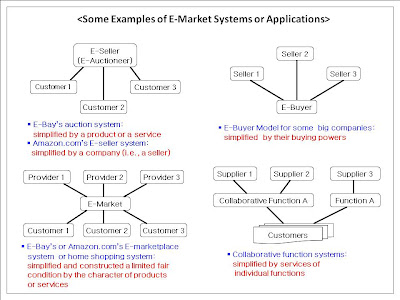
Let us consider some examples.  E-Bay’s auction system is an effort to simplify the rules and standards by a product or a service, and Amazon.com’s e-seller system is an effort to simplify them by a company (i.e., a seller).  However, they both made the mistake of giving up the opportunity of facilitating competition with a fair rule and standard among providers.  The developers of eBay’s or Amazon.com’s e-marketplace system or home shopping system have tried to simplify the system and construct a limited fair rule and standard by the character of products or services.  In this case, only products such as dry goods or services lacking time sensitivity, which are not sensitive to the rules and standards, can be effectively traded through these systems.  Some big companies have tried to simplify rules only by using their buying power to manage purchasing alone (e-buyer model), in effect creating monopolies without fair rules of trade.  Most collaborative e-function systems and applications have also been developed only through simplifying them by services of individual functions.  There are many other cases, but almost all of them have this characteristic aim:  an immediate increase in productivity and efficiency.
At a glance, people might wonder what is wrong with these. Actually, things have gone wrong from the beginning for the employment situation in the market or economy, but nobody has recognized why it has happened and how serious it has been, until now.
Because IT and networking technology have been used mostly in this way for developing those e-market (e-transaction or e-supply chain) systems and applications, (1) the number of transactions and functions in a real market (or supply chain) process has shrunk remarkably—as with Wal-Mart, e-buyer, e-seller, and e-auctioneer systems, and existing e-marketplace systems in the real market process—and (2) numerous collaborative activities to increase efficiency of function have arisen in all sectors of the economy.  Moreover, (3) big companies have developed private information-based supply chain networks in all industries in which they are engaged.  In this situation, employment continually declined, and policies aimed at improving it have been unsuccessful.  Let me explain more details about these:
(1) The number of transactions and functions in a real market (or supply chain) process have been remarkably reduced
This diagram explains how much the reduction of the number of transactions and functions in a real market (or supply chain) process has contributed to the worsening of employment in the economy as a whole.
In the existing functional supply chain process, every supplier has been in the situation of competition by size for more market share.  That is, they suggest similar prices for a similar product--around $10 for a hypothetical product.  If a supplier can offer a better price, such as $9 for Supplier H, by reducing the number of transactions and functions in its supply chain process, it could get more market share. Suppliers B, D, F, G, and I would lose some market share.  It seems nothing is wrong here under the current theory of a free market economy.  Yes, nothing is wrong with the current free market economy, but something else must be seriously wrong, as shown above.
The suppliers, who cannot offer better prices, as well as the small wholesalers and retailers in their supply chains, lose their businesses.  That is, the whole supply chain in this market becomes unstable:  loser suppliers are easily destroyed, along with their suppliers, and as a result, conditions permitting employment, especially for middle- and lower-income workers in those supply chains, seriously deteriorate.  Some suppliers could be subordinated to a strong function player such as Wal-Mart for survival, but the situation will still worsen.
Let me ask you directly:  “Can you change this worsening course of the employment situation with the old economic policies or stimulus plans?”  I believe it to be impossible in most existing functional supply chain processes.  That’s the real problem.
(2) Numerous collaborative activities to increase the efficiency of market functions have created oligopolies
This diagram explains how increasing the efficiency of a function itself in the existing functional supply chain process through collaboration has contributed to the weakening of employment in the economy as a whole.
Structurally, the more the collaboration for a separate function is activated, the worse employment levels become, under competition by size for share.
As seen in Diagrams (1) and (2) together, the efforts for efficiency increase in this existing functional supply chain process have contributed to the weakening of employment in the economy as a whole, unavoidably and continuously.  This worsening employment condition has had a greater impact on middle- and lower-income workers than anyone else.  On the other hand, those same efforts have provided a better opportunity for increasing income to the more affluent.  Thus, there has been a greater polarization between poor and rich due to market forces. 
Here, a question could be raised: Can the existing functional supply chain process with competition by size for market share be changed only by manipulating the constituent factors of the transactions such as products, services, providers, and customers?  Structurally, it’s impossible.  Without directly overcoming the restriction of time and space, it will be almost impossible to construct a fair rule and standard for all in the real market process.
(3) Many private information-based supply chain networks have been developed in all industries of the market, mostly by big companies
This diagram shows Zara’s case as an example.  Zara, the largest clothing company in the world, developed a private information-based supply chain network by vertically integrating its logistics and collaborative functions through the use of IT and networking technology and now needs just two weeks to develop a new product and get it to stores, compared with a six-month industry average, enabling Zara to launch around 10,000 new designs each year, far more than its competition.
Zara has been remarkably successful over the last 20 to 30 years, and as a result, Amancio Ortega, Chairman of Zara, was named the ninth richest person in the world by Forbes in 2010.
But what happened to others in the industry?  Most small individual designers and manufacturers were much less competitive than Zara, and only some of them could be absorbed by Zara.  As usual, the employment situation for middle- and lower-income workers in this industry has seriously and relentlessly deteriorated.  Unfortunately, Zara is no longer an isolated case.
Large companies in every industry have developed similar private information-based supply chain networks for their own distribution, and those big companies have used their supply chain networks only for their own benefit.  Thereafter, sadly, the employment situation for middle- and lower-income workers has seriously worsened in almost all industries, worldwide. 
Strangely enough, this situation is just as if there were no public bridges or tunnels in San Francisco or New York – no Golden Gate Bridge, no Lincoln Tunnel.  Correspondingly, no effective public information-based supply chain infrastructure has been developed in the real supply chain processes of the market.  That’s the real problem, but without directly overcoming the restriction of time and space, it will be almost impossible to develop a public supply chain infrastructure in the market.
The Changed Economic Environment in the Modern Information Age
More seriously, these events have contributed to the shift to a more efficiency-oriented supply side environment and changed the whole economic environment in the Modern Information Age.  That is, a mutually complementary relationship between the supply side and the existing market process has been firmly established, and this has completely altered the economic environment. 
Yet these changes also resulted in increased difficulties in job creation for middle- and lower-income workers and in a wider polarization between the poor and the rich.  Moreover, they have contributed to the weakness or near collapse of the general service industry and aggravated unemployment.  In my view, the existing market process has been so efficiency-oriented that it has not created enough businesses and jobs to keep consumer spending at the desired level.  This is strongly correlated with the decline of the self-generation, or recovery, capability of the economy.  This illustrates once again why Henry Ford paid premium wages to his workers:  he wanted them as customers.  But the workers impoverished by Zara cannot afford even its cheaper goods.
The decline in the self-generation capability of the market has reduced the level of consumer spending over time (Force [1]).  I believe this has been the most important factor in the worsening of the recession. (The self-generation (or recovery) capability of the market:  The market itself generates enough businesses and jobs, and also enough efficiency increase, to keep consumer spending at desired levels.)
To promote the level of consumer spending, there seemed to be little choice other than expansionary fiscal and monetary policies, along with stimulus plans, to keep the economy going.  These measures have tended to act as a force to increase consumer spending (Force [2]) to promote growth and prosperity.
When Force [2] is more powerful than Force [1], growth appears in many parts of the economy.  However, the problem is that Force [1] is a continuous force, and Force [2] only temporary.  That is, when Force [2] disappears and Force [1] continues, the economy falls back into recession.  Thus, we have repeatedly adopted excessive expansionary economic policies and enacted stimulus plans to stave off recession over the last nine to ten years.  These only postponed the inevitable deep economic decline into which we have now descended.
Because we have adopted these expansionary economic policies and stimuli too often as a stopgap, we have experienced serious side effects in the market:  (1) budget deficits and privatization of public goods and services at both the local and federal levels have increased significantly; (2) because of huge liquidity increases, various economic bubbles formed, as in  commodities and real estate; thus, (3) the potential for inflation increased; and (4) other abnormal phenomena accumulated in the market.  Each of these contributed to a sudden lowering of the level of consumer spending to propel the economy into deeper recession.
What of course precipitated this crisis – i.e., the immediate cause -- was that we did not effectively regulate the creation of over-leveraged financial products such as sub-prime mortgage products.  Despite the potential risks of those products, financial institutions went ahead, as it was felt they contributed to increasing the level of consumer spending.  We now know better.  So, to our peril, we did not put a stop to what we now recognize as a dubious policy that exacerbated the situation.  Finally, from the housing market bubble burst to the current financial meltdown and Federal budget crisis, the economy has plummeted to a perilous level.
What is the real cause of the current economic crisis?
So, what is the real cause of the current economic malaise?  Is it still the housing market bubble burst or the sub-prime mortgage system failures?  These are just secondary or incidental causes.  Then, what underlies them? 
I can see free-market ideologues cringe now.  But with the market (or supply chain) process as it exists, the economy as a whole cannot self-generate enough businesses and jobs and also enough efficiency increase to keep consumer spending at the overall desired level.  That is, the existing functional supply chain process for the real market is too heavily efficiency-oriented and no longer suitable for the modern information market.
What has caused this existing functional supply chain process to be too heavily efficiency-oriented?  It appears to be fact that we have not developed any effective e-market (e-transaction or e-supply chain) systems or applications for real transactions by directly overcoming the restriction of time and space (i.e., by directly improving the conditions of real-world processes). Oddly, the conditions of real-world processes have not been considered at all, and accordingly, constructing a fair rule and standard for all has been ignored. This is wrong.  So, I believe the real cause must be the disregard of the conditions of real-world processes in developing those e-market (e-transaction or e-supply chain) systems or applications for real transactions in the Modern Information Age.
Why were real-world processes disregarded?
I would refer to something called the ant death spiral, an event that occasionally takes place in the natural world.
The cause of this behavior is the technology ant societies use for ground navigation. They follow pheromone trails on the ground laid down by other ants, or they simply follow other ants visually. The system works well normally.  A scout ant goes out and finds food.  Other ants go back to get more by following the scent trail, or by following each other.  However, if a loop gets created, the ants will march blindly, sometimes circling until they die.
Unfortunately, it seems that human beings sometimes exhibit similar behavior by blindly following the previous order.  I think we have made the same mistake in the economy over the last 20 to 30 years of the Modern Information Age, and it has created an economic death spiral.
I think it’s time to break down this cycle and explore a new order for survival.  This time we may be saving the world economy.
What should we do? What could be the solution?
Real transactions are directly restricted by time and space.  Without directly overcoming the restrictions of time and space, it is almost impossible to construct an effective e-market (e-transaction or e-supply chain) system for real transactions defined as an e-marketplace system with a fair rule and standard for all and a public information-based supply chain infrastructure in the real market process.
By directly limiting the restrictions of time and space, such as directly limiting the market ranges, the same services (i.e., delivery times) of offerings from providers and the same price of like offerings from a provider at the final delivery point as a fair rule and standard for all would be established to construct an effective e-marketplace.  By operating the public supply chain infrastructure in the limited market range, the integration of a supply chain would be facilitated to construct a system as a platform in the supply chain (real market) process like the Internet as a platform in information.
I believe a public information-based supply chain infrastructure system with an effective e-marketplace can easily be developed that will overcome the restrictions of time and space by using IT and networking technology. 
If a public information-based supply chain infrastructure system is developed and fully implemented in the real market, the existing efficiency-oriented market process would be changed to a more effectiveness-oriented market process, which is more suitable for the modern information market.  This would significantly contribute to the improvement of employment on the whole.  The self-generation capability of the market would improve as well. 
With the influence of this new, more effectiveness-oriented supply chain process, the existing competition by size would change into competition by quality and service.  The existing efficiency-oriented mass production process and mass-market consumption model would also be altered into a more effectiveness-oriented, diversified, or individualized production and consumption system.  Owing to these changes, local employment conditions would improve considerably, and the business environment for middle- and small-sized companies and for the general service industry would improve significantly.  Moreover, companies that off-shored and outsourced to lower labor cost countries would come back to the domestic arena.
As a complementary relationship is established between the supply side and this new effectiveness-oriented market process, job creation for middle- and lower-income workers would be enhanced, and the polarized gap between poor and rich moderated.
This synergy for employment would be a positive force for economic recovery and revitalization.  The improvement of the self-generation capability of the market could finally be transformed into a permanent structural force to steady, and then increase, the level of consumer spending. 
In this scenario, a policy for a well-functioning economic environment could be established, and expansionary economic policies would rarely be needed.  Thereafter, the budget deficits at both local and Federal levels would decline, and many economic anomalies be resolved naturally.
I strongly believe that this is the most effective path to get out of the current economic crisis and to revitalize the economy. 
I hope this public information based supply chain infrastructure system with the efficient e-marketplace can be developed as soon as possible, implemented quickly and effectively in the market, and save the world economy.

About the Author
Ho-Hyung (“Luke”) Lee (luke.h.lee@ubims.com ) is by training a lawyer, an international businessman and entrepreneur – and an inventor. He is currently the CEO of UBIMS, Inc. ("Ubiquitous Market System"). UBIMS, Inc., is a patent-pending startup with a cloud-based software designed to link manufacturers and businesses directly, provide time and cost savings in supply chains, and promote new job and business formation as outlined above, particularly in “A New Supply Chain Process for the Modern Information Market.”

Monday, October 24, 2011

Parable of the Metropolis on a River

by Luke Ho-Hyung Lee and Jess Parmer
Let’s suppose a large city straddles a sizeable river, and that commerce between its two halves was carried out with boats and barges originally.  As this city passed into modern times and its commerce grew, it became clear that for business to grow, one or more bridges had to be built by the largest companies, which restricted travel to their own vehicles running between the company and its suppliers, or between the company and its markets, across the river.

Problem solved, right?  Well, problems never cease, so let’s consider the new economy which the bridges created.
Unemployment rose sharply
1.       Because the first large company to build a bridge for supply and commerce was quickly imitated by other large companies, the small companies were confined to using boats and barges, so that many of the small companies went out of business, and thousands, even tens of thousands, of jobs were lost, never to return.
2.      Because efficiency became the main issue for competition, every company, both small and big, actively sought any possible way to increase its own efficiency, and coming into the Modern Information Age these efforts focused on adopting IT for productivity increases; off-shoring and outsourcing to lower labor cost cities or countries; and adoption of robotic machines and automation in manufacturing processes.  These worsened the employment situation in the city.
3.      Moreover, because those bridges had been developed mostly by big companies and used only for their own benefit, the market entry of new products or new businesses developed by small companies and individuals were structurally blocked.  Only a few new products or new establishments developed by big companies were easily introduced into the market on planned schedules.  This led to a new type of monopoly or oligopoly tailored to the Modern Information Age, and in this situation job creation eroded, and the large companies became known as net job destroyers.
Decline of Consumption
In this situation, the employment condition of the city steadily worsened, and, as a result, the level of consumer spending also fell.  At some point, a vicious cycle between the supply side and the demand side arose in the economy of the city.
Rise of Pronounced Income Inequality
Because it was very difficult and expensive for each company to build such bridges independently, only big companies could easily build, and a structurally unfair trade condition led to the dominance of the big companies and their workers over the small companies and their workers.  In this situation, income inequal­ity between rich and poor ballooned. Political turbulence increased, and several large companies, along with larger mid-sized ones, collapsed financially, even as interest rates fell into negative real figures, adjusted for inflation.  Lend-ing virtually ceased.
What is the real cause of these problems?  And what could be the solution?
Clearly the cause of the problems in the city of the parable is that there were no public bridges.  Without public infrastructure, supported by widely held relevant concepts, no solution can emerge.  Instead, it is revolutionary concepts which become paramount—concepts drawn from outside the crippled economy—and shed light enough for solutions to be found.  What is needed is an economic fulcrum point.
The politicians and the business persons running the large companies are too conservative to see this.  Their faith in the pronouncements of economists leads them to adopt ever less promising policies:  they encourage speculative real estate investment; new stock and bond issues flower almost overnight; banks and brokers develop new instruments for speculating in commodities; even new boats and barges are built.  The city’s government demands as the price of political peace that the unemployed be fed, housed, clothed, and protected from disease and physical disability, assuming as public debt the services once supplied by the large companies, and even some small ones.  Meanwhile, the remaining large companies pursue ever more stringent efficiencies, further reducing the opportunities for economic expansion for the capital not already in their hands, and some banks manage to make even more money than the large companies.  Tax evasion becomes a civic sport.
Then, what should the people and leaders of the city do to solve such major problems and revitalize the economy?  The revolutionary idea is that they should construct bridges for public use as soon as possible.  If appropriate infrastructure in the form of bridges is constructed on the river, many of the city’s major problems could be solved without serious confusion or outlandish expense, and the economy would be revitalized
A Bridge between Suppliers and Customers in the Modern Information Age
Let’s suppose that there is a river between suppliers and customers in the market.  How have we crossed this river?
Before the Modern Information Age, more specifically before IT and information networking technology was as advanced as in the Modern Information Age, we could cross the river by using various supply chain functions in the market, such as wholesalers.  These supply chain functions were like those ships and barges on the river.
One day in the Modern Information Age, a company named Zara developed supply chain networks for its product or service distribution by integrating them with its upstream supply chain through the use of IT and information networking technology and crossed the river.  The result was tremendous.  Its efficiency and market effectiveness became far superior to that of other companies.  Thereafter, many other companies in every industry also tried to develop the same information based supply chain networks as Zara’s.  Those information based supply chain networks were like the private bridges on the river.
However, since a seller’s customers typically are geographically scattered, and significant expense and effort are required to operate actual distribution functions such as warehouses and distribution centers, it has typically been very difficult and expensive for each company to develop such networks independently, even if they could utilize the information technology.
Moreover, like the private bridges in the city of the parable, today’s big companies have permitted use of their own information based supply chain networks only for their own benefit.  That is just as if there were no public bridges in San Francisco–no Golden Gate or Bay Area Bridges.  Correspondingly, no public information based supply chain infrastructure has been developed in the market.  This has been the real problem, and the same major problems in the economy of the parable’s city, such as lower employment, reduced consumption, and income inequality have also occurred in the actual economy.
Public Information Based Supply Chain Infrastructure as a Solution
On September 8, 2011, President Obama shared his ambitious plan for the American Jobs Act to grow our economy.  Will it work?  As in the city of the parable, without first developing the information based supply chain infrastructure as a bridge for public use, I believe it will be almost impossible to solve our current economic problems and revitalize the economy, no matter how powerful the economic policies or stimulus plans adopted.  The President’s plan might be able to fend off urgent problems for a time but could also create or accumulate unforeseen abnormalities in the market.  It lacks a revolutionary fulcrum point.
Then, together with the development of a public information based supply chain infrastructure, could his plan be effective?  It could be--if this remedy is adopted as soon as possible and implemented in the market quickly and effectively, I believe that it will solve current major economic problems including job creation and revitalizing the economy.
Some might still wonder how a public information based supply chain infrastructure could change the whole economic situation quickly and effectively.
Information is instantly effective all over the world in the Modern Informa­tion Age.  The information based supply chain infrastructure is the public supply chain infrastructure that will be operated by information.  Operating software for the public supply chain infrastructure could be easily developed and implemented all over the United States.  I believe the solution for the software is already in sight.  It only needs to be developed and implemented.  To do it, or not to do it, that will be totally up to those who invest in it.  But we stand now on the edge of a double-dip recession and possibly another Great Depression.  Time is not on our side. 

About the Author
Ho-Hyung (“Luke”) Lee (luke.h.lee@ubims.com ) is by training a lawyer, an international businessman and entrepreneur – and an inventor. He is currently the CEO of UBIMS, Inc. ("Ubiquitous Market System").
Jess Parmer (jess.parmer@ubims.com ), Ph.D., by training a classicist and archeologist, owns and operates a small business.  He is a partner in UBIMS, Inc.
UBIMS, Inc., is a patent-pending startup with a cloud-based software designed to link manufacturers and businesses directly, provide time and cost savings in supply chains, and promote new job and business formation, particularly in “A New Supply Chain Process for the Modern Information Market.”